What is Pentecost?
Imagine you’re in an upstairs room in Jerusalem. It’s been fifty days since Passover. Outside, the streets are still crowded with pilgrims who’ve traveled from every corner of the ancient world for the festival season.
And then — without warning — the room erupts.
A sound like a violent, rushing wind fills the house. What look like tongues of fire appear, settling over the heads of everyone gathered there. And people begin speaking in languages they’ve never studied, while a bewildered crowd outside hears their own mother tongues spoken by Galilean fishermen.
If you’ve ever read Acts chapter 2, you’ve encountered this scene. And if you’re like most people, your first reaction is probably: what on earth is going on?
Here’s what I’ve come to believe: there is a perfectly logical reason for every single element in that room. Wind, fire, languages, the specific date — none of it is random. But to understand it, we have to travel back roughly 1,500 years, to a mountain in the middle of a desert wilderness. Because what happens in Acts 2 isn’t new. It’s a deliberate, carefully constructed echo of something ancient.
This is what Pentecost really is — and why I think it’s one of the most quietly profound stories in the entire scriptural tradition.
Watch the Video Here
First, a Word About the Name
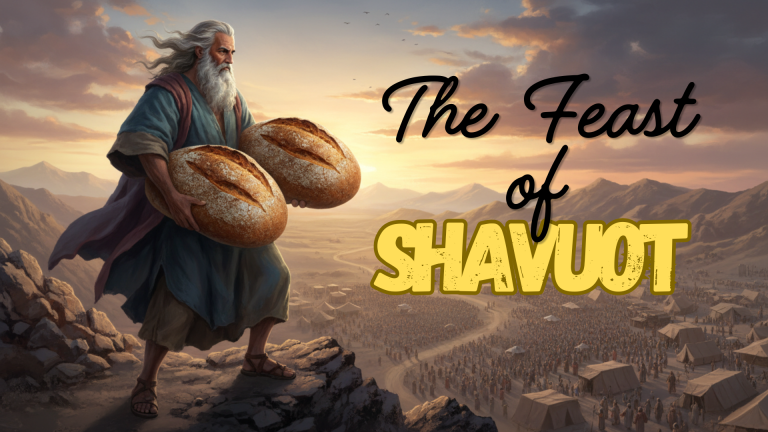
The word Pentecost comes from the Greek word for “fifty.” It’s the Greek name for the Jewish festival called Shavuot — the Festival of Weeks — which falls exactly fifty days after Passover.
By the first century CE, Shavuot had grown into one of the three great pilgrimage festivals of the Jewish year, alongside Passover and Sukkot. That’s why Jerusalem was packed with Jewish pilgrims from across the diaspora when the events of Acts 2 unfolded. The book records visitors from Parthia, Media, Elam, Mesopotamia, Judea, Cappadocia, Pontus, Asia, Phrygia, Pamphylia, Egypt, Libya, Rome, Crete, and Arabia — a remarkable cross-section of the ancient world gathered in one city.
The timing matters. The fact that all of this happens on this feast, on this day, is not incidental. Because in the ancient Jewish world, Shavuot carried an association that most modern readers have lost: it was the anniversary of the giving of the Torah at Mount Sinai.
And that connection is the key to everything.
A Pit Stop on the Way to Canaan
Let’s back up to the beginning of the story.
When God sent the plagues on Egypt, he was beginning to fulfill a covenant promise made to Abraham generations earlier: that Abraham’s descendants would become a great nation, that they would spend a long season in Egypt, and that they would eventually return to inherit the land of Canaan.
The story of Passover — the lamb’s blood on the doorposts, the death of the firstborn, the crossing of the Reed Sea — is the opening movement of that homecoming journey. The children of Israel are headed somewhere. They have a destination. But before they can enter the land, God gathers them at a mountain in the Sinai wilderness for an encounter that will define everything that follows.
And this gathering happens roughly fifty days after the exodus from Egypt — fifty days after Passover.
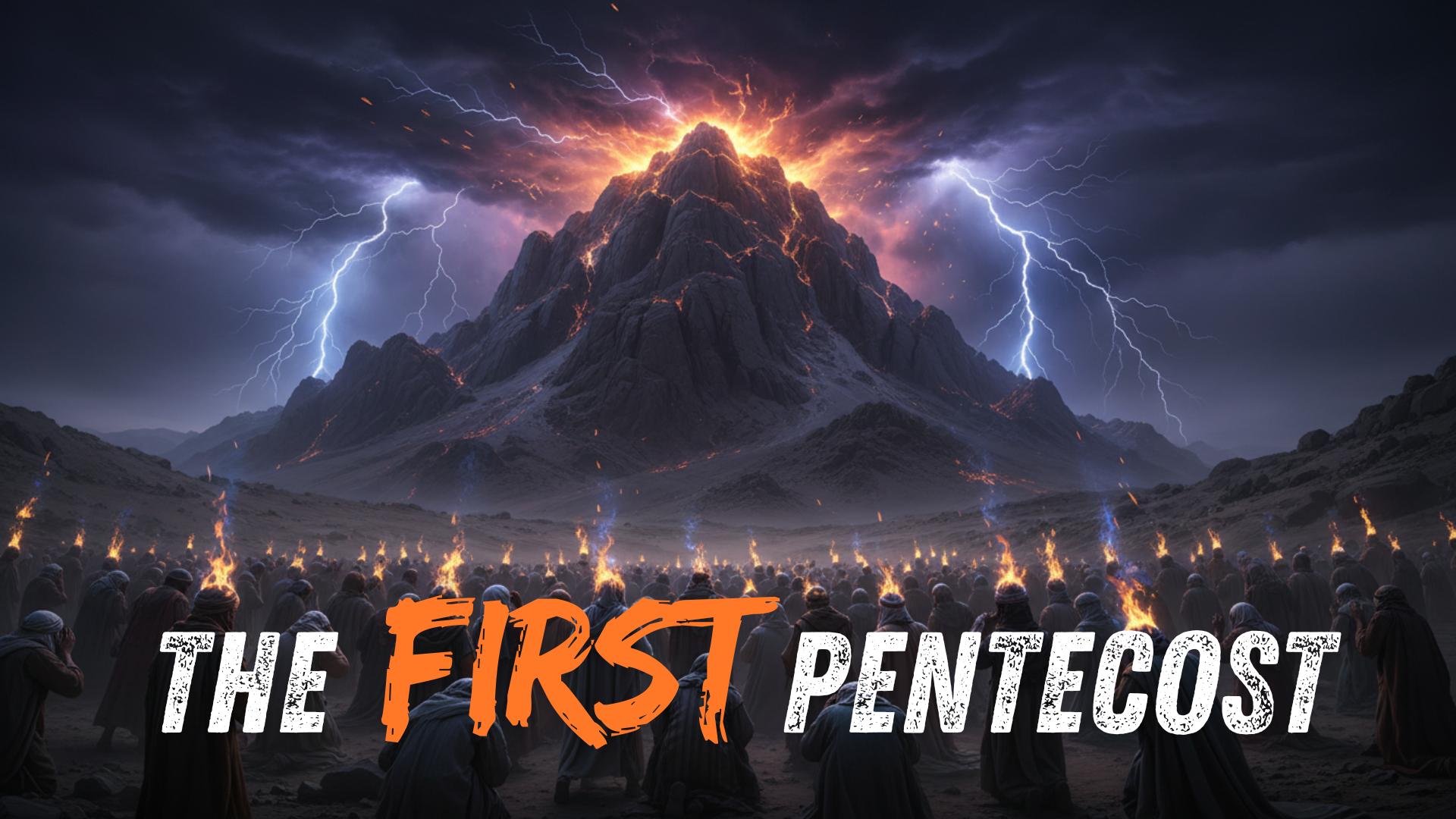
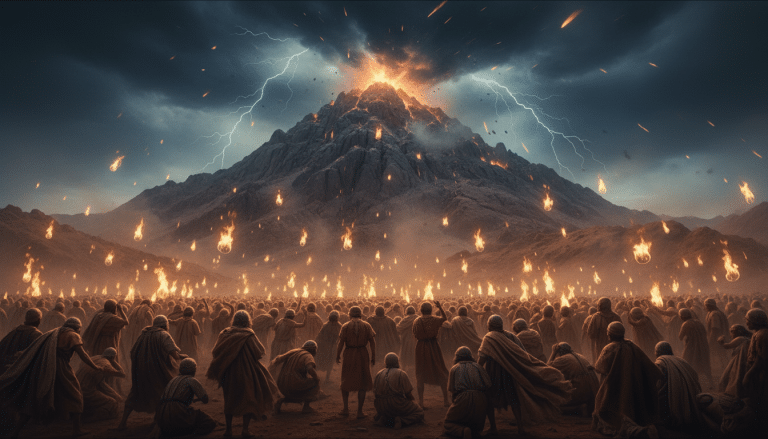
Picture the scene described in Exodus 19. Thousands of people are camped around the base of Mount Sinai. They’ve been instructed to consecrate themselves and to keep their distance from the mountain. And then the third day comes, and the mountain erupts:
A thick cloud descends on the summit. Lightning splits the sky. Thunder rolls continuously. A sound like a massive ram’s horn — a shofar — begins to blow, growing louder and louder. The mountain shakes. The peak smokes and blazes. And from within the fire and cloud and thunder, God speaks.
He begins with the Ten Commandments. But the scene itself — the visual and auditory drama of it — is as important as the content, and the ancient interpreters knew it.
Something Strange in the Hebrew
The account runs through Exodus 19 and 20, and most of it is dramatic but comprehensible. Thunderclouds, earthquakes, supernatural fire — extraordinary, but imaginable.
Then we hit a verse that stops careful readers cold.
In most English translations, Exodus 20:18 reads something like: “Now when all the people saw the thunder and the flashes of lightning and the sound of the trumpet and the mountain smoking…“
But that’s not a precise translation of the Hebrew.
The Hebrew reads: “All the people saw the voices and the torches.”
Saw the voices. Not heard — saw!
This is one of those odd phrases in ancient Jewish biblical interpretation, and the rabbis whose insights are preserved in the Midrash and the Talmud wrestled with it seriously. One explanation, preserved in the Exodus Midrash, offers this striking image:
On the occasion of the giving of the Torah, the children of Israel didn’t merely hear the Lord’s voice — they actually saw the sound waves as they emerged from His mouth. They visualized them as a fiery substance. Each commandment traveled around the entire camp and then came back to every individual. (Exodus Midrash)
Words of fire, moving through the assembly, landing on every soul at the mountain.
Seventy Languages for All the Nations
The Talmud adds one more detail that shifts the meaning of everything.
In the tractate Shabbat 88b, the school of Rabbi Yishmael offers a comment on a verse from Jeremiah: “Is not my word like fire, declares the Lord, and like a hammer that shatters a rock?” Just as a hammer striking rock sends fragments flying outward in every direction, the rabbis observe, so too each utterance from the mouth of God at Sinai divided — into seventy languages.
Seventy languages. In the ancient Jewish world, seventy was the symbolic number of all the nations of humanity, drawn from the Table of Nations in Genesis 10, which enumerates seventy peoples descended from Noah after the flood. When the rabbis say the Torah went out in seventy languages, they’re making a statement that goes far beyond Israel: the voice of God at Sinai was addressed to all of humanity.
Now the full picture of the ancient tradition comes into focus. At Sinai, there was fire, a rushing wind, thunder, a shofar blast, and the mountain shaking. When God spoke, his words went out as visible tongues of fire, traveling to every person present, and they were spoken — or heard — in the languages of all the nations.
I think you can see where this is going.
Pentecost Is Mount Sinai — Take Two
The writer of Acts knows these traditions. He is a first-century Jewish writer steeped in the scriptures and the living interpretive culture that surrounded them. And he is making a deliberate, unmistakable point when he sets the scene in Acts 2.
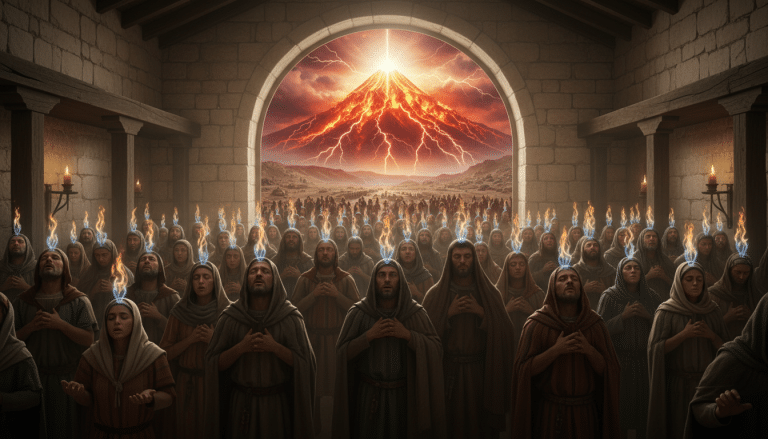
Wind. Fire. Tongues of flame resting on individuals. People from every nation hearing in their own languages.
This isn’t an accidental collection of dramatic signs. It’s a carefully composed echo. The same elements as Sinai, in a new key. He wants his readers — who would have recognized the Sinai imagery immediately — to ask: if this is Sinai, then what Torah is being given?
To understand the answer, we need to look at what happened after the first Sinai.
The Torah, the Land, and What Went Wrong
The giving of the Torah at Sinai carried a conditional dimension. Before the children of Israel could enter the land of Canaan and live there under the fullness of God’s blessing, they needed to align their communal life with what the Torah described: justice for the poor, care for the stranger, honest commerce, sabbath rest, radical hospitality. At its heart, as the tradition would later summarize it, the Torah called for love of God with the whole self and love of neighbor as oneself.
The warnings were serious: if they kept this covenant, they would flourish in the land. If they abandoned it — if they kept the outer forms while neglecting the inner substance of mercy and justice — the land itself would reject them.
The prophets spent generations trying to hold this tension. Amos, Isaiah, Micah, Jeremiah — they weren’t primarily concerned with ritual failures. They grieved the abandonment of justice for the vulnerable, the corruption of the courts, the accumulation of wealth at the expense of the poor. These were the things the Torah was most fundamentally about.
And eventually, exactly as Moses had warned in Deuteronomy 28, the people were scattered among the nations. First the northern kingdom, then Judah. Exile.
But the Prophets Carried a Second Message
Alongside the warnings of exile, the prophets carried a promise — one of a transformation so deep it would address the root problem.
The problem, as the prophets saw it, was not primarily external. It was internal. The instructions were there, written clearly in stone, but something in the human heart resisted them. The tendency to harden — toward the neighbor, the stranger, the vulnerable one — was stronger than the command to soften.
So God promised, through Jeremiah, a new covenant — one fundamentally different from the Sinai covenant:
“I will put my law within them, and I will write it on their hearts… I will be their God, and they shall be my people.” — Jeremiah 31:33
And through Ezekiel:
“I will remove the heart of stone from your flesh and give you a heart of flesh. And I will put my Spirit within you, and cause you to walk in my statutes.” — Ezekiel 36:26–27
The stone tablets would become living hearts. The external code would become an internal reality. And the mechanism of this transformation would be the Spirit within — not external obligation but inward renewal.
This is the promise that Acts 2 claims is being fulfilled.
The Wind, the Fire, and the Writing on Hearts
When the Spirit descends at Pentecost — with the rushing wind, the visible fire, the languages of the nations — the author of Acts is saying: this is the Sinai moment the prophets foretold.
The first Sinai was the giving of the Torah written in stone, as instruction for a people about to enter a land. The second Sinai — Pentecost — is the giving of the Torah written on human hearts, as the Spirit that makes genuine obedience possible from the inside out.
The long arc that began in the wilderness reaches a new chapter. The same fire, the same wind, the same utterances going out in the languages of all the nations — but this time, the inscription medium is the human heart.
It’s a breathtaking bit of literary and theological architecture. And it changes how we read both stories.
What Does This Mean in Practice?
Here’s where I want to be careful, because it’s easy to miss the point.
It’s tempting to make Pentecost primarily about the dramatic phenomena — speaking in tongues, visible fire, extraordinary experiences of spiritual power. Those things are in the text and I’m not interested in explaining them away.
But the entire arc we’ve been tracing — from Sinai through the prophets to Acts — is pointing at something more fundamental than signs and wonders. It’s pointing at the content of what gets written on the heart.
And the content, across the whole tradition, is love.
The Torah at its center is not primarily a legal code. When the ancient teachers were asked to summarize the whole thing, the answer was consistent: love God with everything you have, and love your neighbor as yourself. Everything else, as Rabbi Hillel famously put it, is commentary.
The prophets who mourned Israel’s failures weren’t primarily mourning ritual violations. They were mourning the hardened heart — the heart that had become indifferent to the suffering of the neighbor. “What does the Lord require of you?” Micah asks. “To do justice, and to love kindness, and to walk humbly with your God.”
If the Spirit comes to write the Torah on human hearts, the deepest thing being inscribed is the capacity to love — genuinely, concretely, without calculation.
I find that every wisdom tradition I’ve spent time in arrives at this same place, from different directions. The Sufi speaks of fana — the dissolution of the isolated self in the Divine Beloved — which produces an overwhelming compassion for all beings. The Buddhist speaks of bodhicitta, the awakened heart that spontaneously orients toward the liberation of every creature. The Taoist speaks of wu wei — effortless action in alignment with the Way — as the natural movement of the person who has stopped fighting their own deeper nature. The Stoic speaks of living in accordance with logos, the rational principle of love and order that underlies the cosmos.
Different languages. One fire.
And Pentecost, read in its full context, is claiming that this is what spiritual transformation looks like in the Jewish and Christian streams: the hard heart becoming soft, the cold heart becoming warm, the self-concerned heart becoming other-oriented.
Not because you’re trying harder. But because something has been written there from within.
The Question Worth Sitting With
If Pentecost is ultimately about love being written on the human heart, then the real question isn’t about what happened in an upstairs room two thousand years ago. The real question is what is happening in us now.
Is the heart softening or hardening? Is the orientation of the inner life moving toward genuine compassion or away from it? Are we, over time, becoming more authentically loving — not as performance, not as obligation, but as overflow?
The ancient Jewish tradition understood Shavuot as a re-receiving of the Torah — not just a commemoration of a past event, but a present, living encounter with the divine instruction. Whatever tradition you come from, that impulse seems worth keeping: the practices and texts and communities that help us remain open to that writing-on-the-heart process.
I’m still very much in the middle of that question myself. But I keep returning to the image from Sinai — words going out as fire, traveling across the assembly, settling on every single person present.
Not on a select few. On everyone.
For Further Exploration
If this connected with something in you, a few paths worth following:
Shavuot and the Torah connection: Almost any good introduction to the Jewish festival cycle will illuminate the ancient traditions surrounding Shavuot. The connection to Sinai was alive and vibrant in the first-century world where Acts was written.
Talmud tractate Shabbat 88b: The discussion of the 70 languages is accessible even in translation and is worth reading in full. It’s a remarkable piece of ancient interpretation.
Jeremiah 31:31–34 and Ezekiel 36:24–27: Read these two prophetic passages side by side, then read Acts 2. The connective tissue between them becomes difficult to miss.
The Table of Nations in Genesis 10: This often-overlooked passage is the foundation for the “70 nations” symbolism that runs through both testaments. Understanding why seventy was the ancient symbol for all of humanity opens up dozens of passages.
I’m sharing all of this as a fellow traveler — someone who finds these ancient connections endlessly fascinating and who keeps returning to them with new questions. These texts have been read and lived in by communities of seekers for thousands of years, and I’m only beginning to understand the depth of what’s in them. If something here stirred a question or opened a door, I’d genuinely love to hear about it in the comments below.
FAQs:
Q: What does the word “Pentecost” actually mean?
A: Pentecost comes from the Greek word for “fifty.” It’s the Greek name for the Jewish festival of Shavuot, which falls exactly fifty days after Passover. That timing is central to why the events of Acts 2 unfold when they do.
Q: Is Pentecost a Jewish holiday or a Christian one?
A: It’s both — though most people only know it from one tradition or the other. Shavuot is one of the three great Jewish pilgrimage festivals, ancient long before the New Testament. The events of Acts 2 take place on that feast day, which is why the author of Acts uses its Greek name, Pentecost.
Q: What is the connection between Pentecost and Mount Sinai?
A: In the ancient Jewish tradition, Shavuot commemorated the giving of the Torah at Sinai. The scene in Acts 2 — wind, fire, and words heard in multiple languages — deliberately mirrors the Sinai account in Exodus 19–20, right down to details preserved in the Talmud. The author of Acts is making the case that Pentecost is a second Sinai event.
Q: Where does the tradition about “seventy languages” at Sinai come from?
A: It comes from the Talmud, specifically Shabbat 88b, where the school of Rabbi Yishmael teaches that each divine utterance at Sinai split into seventy languages — the symbolic number for all the nations of humanity in the ancient world, drawn from the Table of Nations in Genesis 10.
Q: Why were so many people from different nations in Jerusalem at Pentecost?
A: Shavuot was one of the three annual pilgrimage festivals that required Jewish men to travel to Jerusalem. By the first century, Jewish communities were spread across the entire Roman and Parthian world, so the city would have been filled with diaspora Jews from dozens of regions — which is exactly what Acts 2 describes.
Q: What did the prophets Jeremiah and Ezekiel say about Pentecost?
A: Neither prophet mentions Pentecost by name, but both describe a future transformation that Acts 2 claims is being fulfilled. Jeremiah (31:33) speaks of God writing his law on human hearts rather than stone tablets. Ezekiel (36:26–27) describes God replacing a heart of stone with a heart of flesh and putting his Spirit within his people. These passages are the prophetic foundation for how the New Testament interprets the Pentecost event.
Q: What is the significance of the wind and fire in Acts 2?
A: Both elements mirror the Sinai account in Exodus, where the mountain was enveloped in fire, smoke, and a great sound like wind and thunder. In the ancient Jewish interpretive tradition, the divine words at Sinai appeared as visible flames that traveled to each person present. The wind and fire in Acts 2 are deliberate echoes of that imagery.
Q: Is Pentecost primarily about speaking in tongues?
A: The speaking in languages is an important part of the narrative, but within the larger arc — from Sinai through the prophets to Acts — it’s a sign pointing toward something deeper. The languages echo the Talmudic tradition of the Torah going out in seventy tongues to all nations. The central point of the whole sequence is the Torah being written on human hearts through the Spirit, which the prophets described as the fruit of genuine love.
Q: What does Pentecost mean for people outside the Jewish and Christian traditions?
A: The themes at the heart of Pentecost — inner transformation, a shift from external obligation to genuine compassion, love as the fruit of spiritual union — appear across virtually every major wisdom tradition. The Sufi concept of fana, the Buddhist bodhicitta, the Stoic alignment with logos all point toward the same territory. Pentecost is one tradition’s language for a universal human aspiration.
Q: How can I observe or reflect on Pentecost meaningfully today?
A: The ancient Jewish practice around Shavuot included an all-night study of Torah — treating the feast as a living encounter with divine instruction, not just a historical commemoration. Whatever your tradition, that impulse translates: returning to the texts, sitting with the question of what is being written on your own heart, and asking honestly whether the inner life is moving toward greater compassion or away from it.