
Intro
One of the most transforming spiritual experiences I’ve ever experienced happened in the desert on a Saturday morning.
I had driven out to the Saguaro National Forest and found a rock to sit on that overlooked miles of the natural beauty of the place. I did this with regularity on Saturday mornings to gather my thoughts and start meditating.
On this particular morning, as I allowed my mind to settle and focus, I was overcome with the feeling of compassion for everything and everyone. It was so powerful that I looked at a bug crawling across the sand and I just loved that creature with everything in me. I heard a bird, and again, compassion welled up like it was long lost friend.
I don’t know how to explain this experience, but I felt like every creature in the universe was connected in a huge network, like we were all parts of a larger whole. I was one with that bug, and he with me. There was no separation between us.
This sort of transcendent experience has been described by meditators for millennia, but to experience it yourself is incredibly life-altering. I left that rock in what I can only describe as a spiritual high. For three days, I was on the verge of tears at any given time. Imagine participating in a meeting at work and welling up with compassion for everybody at the table. Eventually, the emotional response faded, but the effect that this experience had on me has never left me.
Across thousands of years and every corner of the globe, human beings have been sitting down, turning their attention inward, and discovering something that changes them.
- A Christian monk in a 4th-century desert cave.
- A Buddhist practitioner in a Thai forest monastery.
- A Jewish mystic following the contemplative path of Kabbalah.
- A Sufi whirling in sacred movement.
- A Hindu yogi at dawn.
- And today, a surgeon in Chicago or a schoolteacher in Phoenix sets a timer for ten minutes before the household wakes up.
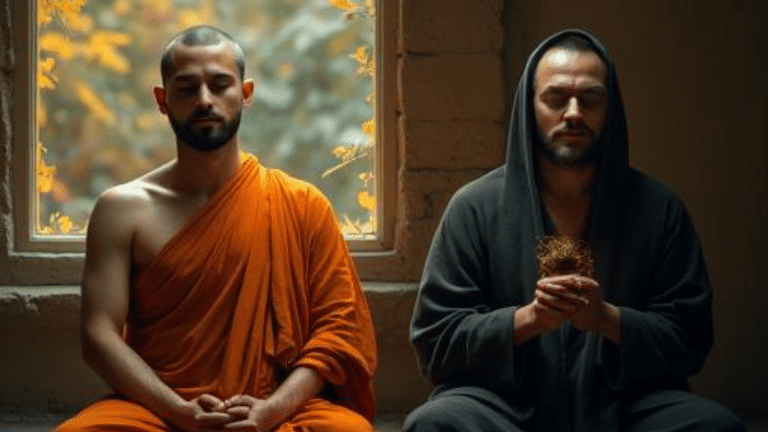
They’re all doing something related. Different words, different frameworks, different metaphysics — but the same essential gesture: learning to be present.
This guide is for anyone curious about that gesture, regardless of where you’re starting from. Whether you come from a deep religious tradition or no tradition at all, meditation belongs to you. It always has.
What the World’s Traditions Agree On
It’s striking, when you look across the landscape of human spirituality, how much convergence there is on this one practice. Virtually every major wisdom tradition developed some form of contemplative discipline — and they arrived at strikingly similar observations about what it does.
Christianity has a rich contemplative heritage often overlooked in modern church culture. The Desert Fathers and Mothers of the 3rd and 4th centuries developed detailed practices of inner stillness. The medieval mystic Meister Eckhart wrote of the necessity of Gelassenheit — a radical letting go, a releasing of the grasping mind. The 14th-century classic The Cloud of Unknowing describes contemplative prayer as a kind of loving attention that transcends thoughts and images entirely.
Buddhism built its entire architecture around contemplative practice. The Buddha’s core teaching on meditation — the Satipatthana Sutta — describes a systematic way of attending to the body, feelings, mind-states, and phenomena as they arise and pass. The goal isn’t to achieve a special state; it’s to see clearly.
Judaism carries deep contemplative streams, particularly in Kabbalah and Hasidic practice. The concept of hitbonenut — deep contemplative reflection — and the practice of hitbodedut (spontaneous, meditative prayer) both point to an interior discipline of attention and presence.
Islam has the Sufi tradition, where practices like dhikr (the rhythmic repetition of sacred names or phrases) and muraqaba (watchful awareness) cultivate a state of deep inward attention. The poet Rumi, perhaps the most widely read Sufi writer in the world today, consistently pointed toward the still center beneath the noise of ordinary mind.
Hinduism gave the world some of its most sophisticated maps of contemplative practice — from the detailed stages of samadhi in Patanjali’s Yoga Sutras to the self-inquiry of Advaita Vedanta. The question “Who is the one who is aware?” — foundational in many Hindu contemplative schools — remains one of the most penetrating spiritual investigations available.
What all of these share is a conviction that the ordinary, distracted, self-preoccupied mind is not our deepest nature — and that through disciplined attention, something more fundamental can be touched.
Modern neuroscience, for its part, has confirmed much of what these traditions claimed. The brain changes measurably with regular practice. Stress hormones decrease. Emotional reactivity softens. The regions associated with self-awareness and compassion grow denser. Whatever framework you use to interpret these changes, the changes themselves are real.
Meditation Is a Skill, Not a Belief
Here is perhaps the most liberating thing about meditation: it doesn’t require you to adopt anyone else’s theology.
If you’re a committed Christian, meditation can deepen your contemplative prayer life and draw you into closer relationship with the God you already know. If you’re a Buddhist, it’s the heart of the path. If you’re Jewish, it connects you to streams of your own tradition that may have been underemphasized in your upbringing. If you’re a skeptical agnostic, the practice stands on its own empirical merits and doesn’t ask you to believe anything beyond what you can verify in your own experience.
This is the extraordinary thing the wisdom traditions were collectively pointing at: the practice works across belief systems because it’s pointing to something more fundamental than belief. Call it presence. Call it awareness. Call it the peace that passes understanding, or the ground of being, or simply what’s here when the noise settles.
The maps differ. The territory is the same.
Three Core Approaches (From Ancient Sources)
Rather than presenting meditation as a single technique, it’s more accurate — and more interesting — to recognize that different traditions developed different approaches, each with its own strengths. Here are three that have crossed cultural and religious lines and proven effective for modern practitioners.
1. Focused Attention (The Universal Starting Point)
Every major tradition begins here: choose an object of attention and return to it, again and again, whenever the mind wanders.
In Buddhist practice, the breath is the most common object. In Christian hesychast practice, it might be the Jesus Prayer, repeated quietly in rhythm with the breath. In Sufi dhikr, it’s the sacred divine name. In Jewish practice, it might be a word or phrase from scripture held gently in the mind.
The technique transcends its container. Whatever you use as your anchor — breath, a sacred word, a divine name from your tradition — the mechanism is the same: you return. Every return is the practice. Every moment of noticing that you’ve drifted and coming back is, in the language of neuroscience, a rep. In the language of many traditions, it’s an act of devotion.
If you find yourself realizing that you’ve been daydreaming for the last 3 minutes, that’s okay. That’s normal. Just come back to your anchor. Over time, your focus muscle will develop and you’ll hold that attention longer.
Start here if: You’re brand new to meditation, or if your mind tends to feel scattered and anxious.
2. Open Awareness (Receptive Presence)
Once some stability develops through focused practice, many traditions describe a natural opening into a broader, more receptive state. Rather than fixing attention on one object, you rest in open awareness — allowing sounds, sensations, thoughts, and emotions to arise and pass without grasping or pushing away.
This is close to what the Christian mystics called resting in God — a kind of receptive, loving presence rather than effortful concentration. It’s also the basis of the secular Mindfulness-Based Stress Reduction (MBSR) program, which has hundreds of peer-reviewed studies supporting its effectiveness for anxiety, depression, and chronic pain.
Zen Buddhism calls it shikantaza — “just sitting.” Tibetan Buddhism speaks of rigpa, or naked awareness. The Quaker tradition of silent worship is perhaps the most widely practiced Christian form of this approach.
The point of this practice is to simply observe the activities of the mind. Over time, you develop an understanding of the transient nature of our thoughts and stimuli. Things come; things go. The only thing that remains the same is you – the observer. You then start to identify less with the activity of your mind and more with awareness itself. You are consciousness.
Start here if: You have some meditation experience and want to move beyond concentration into spacious presence.
3. Loving-Kindness (The Heart’s Capacity)
Among the most cross-traditional practices is the deliberate cultivation of compassion and goodwill — first toward yourself, then radiating outward toward others.
In Buddhism, this is metta meditation — the systematic cultivation of loving-kindness toward yourself, loved ones, neutral people, difficult people, and all beings. In Christianity, it echoes the command to love one’s neighbor as oneself, and the patristic practice of praying for all. In Judaism, the value of chesed (loving-kindness) is considered one of the pillars of a good life — and some Kabbalistic practices cultivate it directly as a meditative quality.
In this practice, you start small – a family member or friend that you feel compassion for. Then you widen the circle and extend that feeling of compassion to your neighbor. You want to genuinely feel it. It’ll seem difficult at first to feel compassion for those you don’t interact with as often, but over time, you will be able to feel it. It’s like a love muscle that needs to be exercised.
Research on this practice shows it increases positive emotion, reduces self-criticism, and meaningfully boosts feelings of connection and empathy. In a world that often feels fractured and divided, it may be one of the most practically needed practices available.
Start here if: You’re dealing with self-judgment, loneliness, grief, or you want to deepen your capacity for compassion toward others.
How to Begin: A Simple First Practice
Wherever you’re coming from — whatever tradition shapes your interior life, or lack of one — here is a practice you can start today.
Set a timer for 5 to 10 minutes.
Research and experience alike suggest that short, consistent sessions build the foundation far more effectively than occasional longer ones. Start small.
Find a posture that is both comfortable and alert. Sitting in a chair with your feet flat on the ground works well. Cross-legged on a cushion, or kneeling — whatever your body allows. The key is to be upright enough to stay awake and relaxed enough to stay still.
Choose your anchor. If you come from a faith tradition, you might use a sacred word, a divine name, or a short prayer phrase from that tradition — whatever carries resonance for you. If you prefer a more neutral anchor, the physical sensation of breathing works beautifully. Either is valid.
When your mind wanders — and it will — return. Without frustration. Without judgment. The wandering is not the problem. The noticing and returning is the practice. You may do this dozens of times in five minutes. That is not failure; it is the exercise.
When the timer sounds, pause before moving. Take a breath. Notice how you feel. Let the practice land before you re-enter the stream of the day.
Do this every day for 30 days before evaluating whether it’s working.
What Gets in the Way (And What It Means)
“My mind won’t stop.” Every tradition that has ever taught meditation has addressed this complaint. The Desert Fathers called intrusive thoughts logismoi — wandering thoughts that pull us from presence. The Buddhist term is papañca — mental proliferation. What they discovered is what modern neuroscience confirms: the goal is not a silent mind, but a different relationship with the noise. You are learning to observe your thoughts rather than be unconsciously controlled by them.
“I feel like I’m doing it wrong.” This is extraordinarily common, especially for people from achievement-oriented backgrounds. There is no “doing it right.” There is only sitting down, choosing your anchor, and returning when you drift. The rest takes care of itself over time.
“It feels self-indulgent.” Many religious traditions have, at times, been suspicious of inward-turned practices — associating them with self-absorption rather than service. But the contemplative witnesses across traditions have consistently argued the opposite: a still, attentive mind is more available to others, not less. You cannot serve from a depleted interior. The mystics who most shaped their traditions — Teresa of Ávila, Rumi, Thomas Merton, Thich Nhat Hanh — were also among the most engaged with the world around them.
“I don’t feel anything spiritual happening.” The fruits of contemplative practice rarely announce themselves during the practice itself. They show up in ordinary life: you notice you didn’t react with anger when you normally would have. You found yourself present with someone who was suffering, rather than mentally somewhere else. The contemplative traditions universally point to fruit as the measure of practice — not peak experiences during the sitting itself.
Making It a Lasting Practice
Anchor it to an existing habit. After morning prayer or devotion, before your coffee, at the same time each day. Consistency matters more than duration.
Let your tradition inform it, not confine it. If you come from a religious background, your tradition likely has its own contemplative resources — perhaps underemphasized ones. The Christian centering prayer movement, Jewish renewal contemplative practice, Sufi-inspired mindfulness programs, Buddhist-derived MBSR — there are entry points from virtually every starting place.
Track it simply. A checkmark on a calendar is enough. The psychology of consistency is powerful.
Give it 30 days before judging. The benefits tend to be cumulative and subtle. Most people notice the shifts not during meditation, but in retrospect — realizing they’ve been less reactive, more present, more themselves.
The Thread That Runs Through All of It
What is remarkable, when you look across the full sweep of human spiritual history, is that people in vastly different cultures, speaking different languages, working within entirely different theological frameworks — arrived at the same core discovery.
That there is a quality of presence available beneath the ordinary noise of mind.
That it can be cultivated.
That cultivating it changes everything.
The words they used for it are different. Shalom. Salaam. Nirvana. The Kingdom of God within. Moksha. Satori. Different maps. But when you read the first-person accounts of those who went deep — across traditions, across centuries — the territory they describe is strikingly consistent.
Meditation is how you begin to explore that territory for yourself.
Not by adopting someone else’s map. Not by leaving your own tradition behind, or by pretending you have no tradition. But by sitting down, turning inward, and seeing what you find when the noise settles.
Every tradition that ever asked you to do that was pointing at something real.
Quick Start Summary
- Choose an anchor: A sacred word or phrase from your tradition, or the breath — both work
- Start with 5–10 minutes daily — consistency matters more than length
- Expect mental noise: Returning is the practice, not achieving silence
- Let your tradition inform it — there are contemplative resources in virtually every faith
- Give it 30 days before evaluating
What tradition or practice shaped your understanding of meditation? I’d love to hear where you’re starting from in the comments.
FAQs:
Q: Do I have to empty my mind to meditate?
No — and this may be the most common misconception about meditation. The Desert Fathers called unwanted thoughts logismoi; Buddhists call it papañca. Every tradition that has ever taught this practice has acknowledged that the mind wanders constantly. The goal isn’t silence — it’s learning to observe the noise without being controlled by it. Every time you notice you’ve drifted and return to your anchor, that is the practice.
Q: Is meditation compatible with my faith?
Almost certainly yes. Christianity, Judaism, Islam, Buddhism, and Hinduism all have rich contemplative traditions — though they’re often underemphasized in modern religious life. Christian centering prayer, Jewish hitbodedut, Sufi dhikr, and Buddhist samatha are all expressions of the same fundamental discipline. Meditation doesn’t ask you to leave your faith at the door; it often opens a deeper door into it.
Q: How long do I need to meditate to notice results?
Most research suggests that even 5–10 minutes of daily practice produces measurable effects over time. The key word is daily — consistency matters far more than session length. Most people begin noticing subtle shifts (less reactivity, more presence in ordinary moments) within 2–4 weeks of consistent practice.
Q: What’s the best time of day to meditate?
The one you’ll actually stick to. That said, most contemplative traditions favor the morning — before the demands of the day take over. Many Christian monastic communities have practiced Lauds at dawn for this reason; many Hindu practitioners meditate at Brahma muhurta, the hour before sunrise. If morning doesn’t work for your life, any consistent anchor point in your day will do.
Q: Do I need an app, a teacher, or special equipment?
None of the above are required. A chair, a timer, and a few minutes are enough to begin. That said, a good teacher or a structured program can be genuinely valuable — particularly if you want to go deeper or connect your practice to a specific tradition. Apps like Insight Timer offer guided practices from teachers across many traditions, which can be a helpful starting point.