Are Humans Exceptional?
I’ve heard people draw a hard line between “nature’s way” and the “way of humans,” as though the two were separate categories entirely. It’s a distinction I’ve turned over for a while now, and I’m not convinced it holds up.
Here’s a small thought experiment. What if a bee argued that its hive’s hexagonal architecture was unnatural, simply because nothing else in nature builds that way? Most of us would call that trait unique, maybe even remarkable — but not unnatural. The bee is part and parcel of nature, so its construction is nature’s own expression.
So if we’re part and parcel of nature too, why do we so often treat human activity differently? Why isn’t a skyscraper, or a symphony, or a supply chain considered as much an expression of nature’s way as a hive? If a trait is unique, does that make it unnatural — or just another data point in nature’s range?
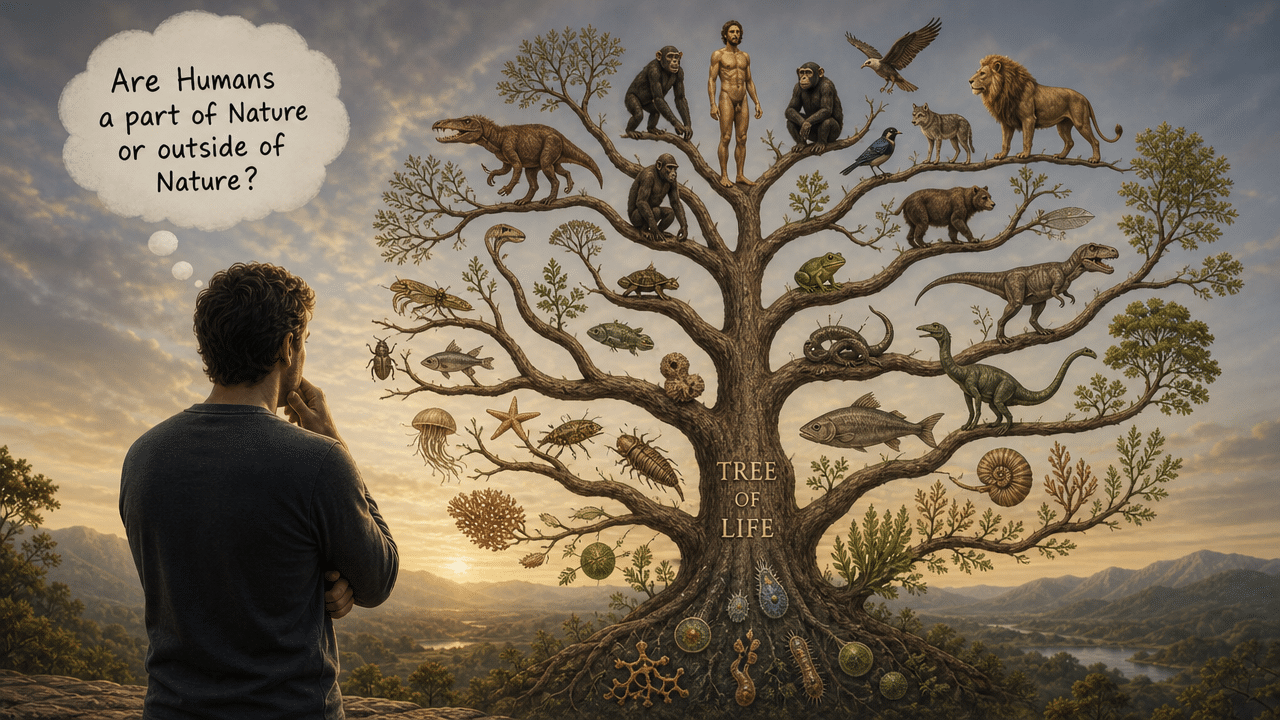
To place humans outside of nature is to make a specific claim: that we are exceptional not just in degree, but in kind. That of every branch on the evolutionary tree, ours alone doesn’t belong to the tree. That’s a bigger claim than it first appears, and it’s worth asking whether it holds.

Two Ways to Be Exceptional
Humans have plainly done things no other species has. We build chemical laboratories and hundred-story towers. We ask questions about meaning and morality and write philosophy in response. No fair account of the evidence denies human exceptionalism. The real question is what kind of exceptionalism we’re talking about — comparative, or categorical.
Comparative exceptionalism says humans do the things other species do, only more so. Primates make tools; so did early humans, roughly 20,000 years ago, working the same kinds of stone. But since then, we kept going — bronze, iron, pneumatic hammers, silicon. The ability itself isn’t unique to us. The degree to which we’ve developed it is.
Think of a 400-meter race. If Johnny is the fastest runner among a field of humans, that’s a claim about degree — Johnny is still a runner, still human, just faster than the rest. That’s comparative exceptionalism. It doesn’t remove Johnny from the category of ‘runner’ or ‘human.’ It just ranks him within it.
Categorical exceptionalism is a different claim entirely. It says Johnny isn’t just faster — he’s not human at all. He’s in a category of his own, and the comparison to the other runners was never quite fair to begin with. Applied to our actual question: categorical exceptionalism says humans aren’t simply the furthest-developed branch of the evolutionary family — we were never part of the family in the first place.
That’s the distinction I want to hold onto for the rest of this piece, because it changes which question we’re actually asking. Nobody serious disputes comparative exceptionalism. What’s worth examining is whether the traditions — and the honest evidence — support the categorical claim.
Categorical Exceptionalism — The Genesis View
The clearest articulation of categorical exceptionalism comes from Genesis 1:26:
“Then God said, ‘Let us make man in our image, after our likeness. And let them have dominion over the fish of the sea, and over the birds of the heavens, and over the livestock, and over all the earth, and over every creeping thing that creeps upon the earth.’”
In this reading, humanity isn’t one species among many — it’s set apart, made in the image of God, and given authority over every other living thing. It’s a coherent, historically significant position, and it’s easy to see its appeal: it offers a clear account of human dignity, a reason for our distinct moral awareness, and an ordering principle for our relationship to the rest of creation.
It’s worth noting that this view is largely particular to the Abrahamic traditions — Judaism, Christianity, and Islam — which together represent roughly half the world’s population. That’s a significant number of people, though of course popularity isn’t the same as truth, and not every Abrahamic believer reads the text this way (more on that later). Still, it’s the clearest and most widely held version of the categorical claim, so it’s the right place to start.
What Other Traditions Say
Step outside the Abrahamic framework, though, and the categorical claim gets much harder to find.
The Hindu and Buddhist View
In the Hindu and Buddhist traditions, the Divine — or Buddha-nature, depending on the school — is expressed through all sentient beings, not humans alone. Recognizing that presence in every living thing is a core practice, not an exception made for our species. There’s no equivalent of ‘made in the image of God’ reserved for humans here; if anything, the image is reflected everywhere.
The Taoist View
The Taoist conception of the Tao is, for practical purposes, indistinguishable from nature itself. Every living thing is an expression of the Tao in equal measure. The Taoist ideal of wu wei — action in harmony with the natural order rather than against it — only makes sense if humans are inside that order to begin with, not standing outside it issuing instructions.
The Stoic View
The Stoics offer something closer to a middle position, and it’s a useful one. They held that humans are indeed distinguished by logos — reason — and that this capacity is genuinely exceptional among living things. But they paired it with the concept of oikeiôsis: an expanding circle of natural affinity that starts with the self and extends outward to family, community, humanity, and the cosmos as a whole. Reason wasn’t a passport out of nature. It was understood as the very thing that bound a person more closely to it, and made them responsible for living ‘according to nature’ rather than against it.
A Bridging View from Within the Abrahamic Traditions
Even inside Judaism, Christianity, and Islam, there’s a long-standing reading of Genesis that treats dominion as responsibility rather than ownership — a theme I’ll come back to at the end. Contemplative and mystical strands within these traditions, along with much of Sufi thought, tend to emphasize the interconnectedness of creation and the presence of the Divine within it, which sits closer to the Hindu, Buddhist, and Taoist views than to a strict reading of dominion.
Taken together, the traditions converge on something worth sitting with: human distinctiveness is real and widely acknowledged. But almost none of them — including significant voices within the Abrahamic traditions themselves — use that distinctiveness to argue humans stand entirely outside nature’s family. The categorical claim turns out to be a minority position even among believers, not the consensus it can appear to be from the outside.
So What Kind of Exceptional Are We?
Two more arguments sometimes get raised in defense of categorical exceptionalism, and both are worth a brief look.
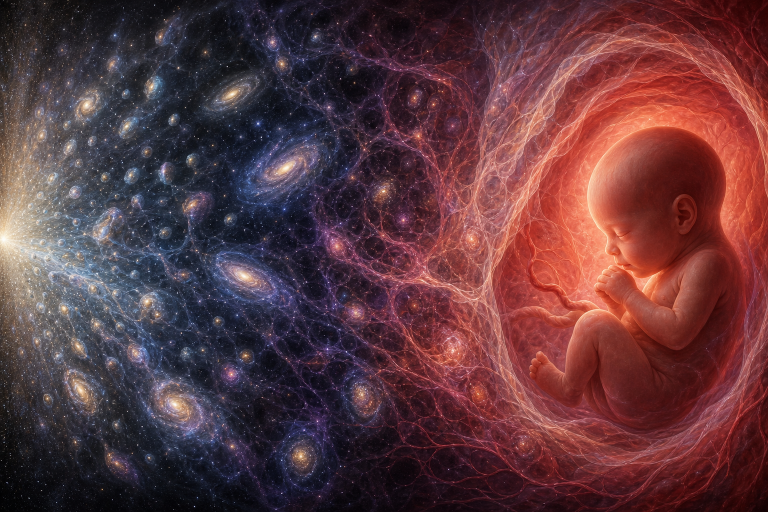
The first says humans are the telos — the goal — of evolution or of the universe’s unfolding: the point at which the cosmos became aware of itself. Even granting that idea some credit, it doesn’t establish categorical exceptionalism. It would only mean humans are the current expression of that self-awareness. Thirty thousand years from now, our evolutionary descendants — who may by then be a distinct species — could carry that same role forward. Nothing about the telos argument requires humans to be categorically separate from our ancestors, siblings, or descendants along that evolutionary line.
The second argument says categories themselves are a human construct, and that our comparative exceptionalism is great enough to earn us a category of our own. This one is really just comparative exceptionalism wearing categorical clothing. Returning to Johnny: he’s still the fastest runner on a team of runners, however large the gap. Being far ahead of the pack doesn’t make him a different kind of being than the pack. And it’s worth remembering that our margin over other hominid species wasn’t inevitable — several close relatives went extinct for reasons that had as much to do with circumstance as capability. Had a few of them survived alongside us, the case for a human-only category would be considerably harder to make.
Put simply: comparative exceptionalism is well supported by the evidence and echoed, in different language, across nearly every tradition examined here. Categorical exceptionalism rests almost entirely on one reading of one passage, held by a minority even within the traditions that produced it.
None of this is an argument against human significance. If anything, it’s the opposite. A comparative account of our exceptionalism still leaves plenty of room for wonder — at the scale of what a species built from the same raw materials as every other living thing has managed to do with reason, cooperation, and time. What changes isn’t the size of the achievement. It’s the story we tell about where that achievement leaves us in relation to everything else alive.
It also changes what we owe. A being that stands entirely outside nature has, at most, a set of instructions to follow. A being that stands within it, distinguished mainly by degree, has something closer to a family obligation — the kind owed by the strongest and most capable member of a household to everyone else living under its roof.
What This Means, Practically
Finding Our Place in the Ecosystem
If life on Earth stretches back roughly 4.3 billion years, and the human lineage split from other primates only 6 to 7 million years ago, our entire history amounts to a sliver of the evolutionary clock. In that sliver, we’ve driven a climate crisis that’s unsustainable at its current pace — and it’s fair to ask whether the doctrine of dominion, taken to its extreme, made that easier to justify.
A being convinced it stands outside nature has less reason to study how nature maintains its own balance. Recognizing ourselves as one species within a family of species opens the door to a different posture: humility, and a willingness to learn from the balance other species have already found.
Using Resources Regeneratively
Using the earth’s resources isn’t the problem — every species does it. Bees take pollen and pollinate flowers in return. Birds gather sticks and feathers to build nests that eventually return to the soil. What distinguishes a sustainable relationship with resources from an extractive one is simply balance: what a species gives back relative to what it takes.
There’s no reason humans can’t mine, build, and grow food while regenerating the land in the process — through regenerative agriculture, responsible permaculture, and better-designed habitats. Other species have been doing versions of this for millions of years. We’re capable of learning it too.
Does Exceptional Ability Imply Responsibility?
Back to Johnny. Suppose the team’s survival depends on someone making a long, difficult run for help, and Johnny — by far the fastest — protests that he’s just one runner among many and shouldn’t be singled out. Most of us would find that unconvincing. Ability creates a claim on responsibility, even without a category shift to justify it. Jesus put it plainly in Luke 12:48: ‘To whom much is given, much is required.’
Whatever one believes about the origins of the current climate crisis, humans remain the only species with the cognitive capacity to study nature’s own methods of repair and apply them deliberately. That capacity alone is a reasonable basis for taking up the work — not because we’re categorically separate from nature, but precisely because we’re not.
A Brief Word on Eating Meat
One implication sometimes drawn from human responsibility is that we shouldn’t eat meat at all, since it requires the death of another living thing. I’d push back gently on the premise — humans are biological omnivores, and omnivory is a normal, unremarkable feature of nature’s design. The more honest question isn’t whether we eat meat, but how. Predator populations in nature stay in balance with prey populations through scarcity and effort; at 8 billion people, we’ve built systems capable of driving prey species to extinction and industrializing the process in ways no natural predator ever could. That’s a genuine tension, and one that probably deserves its own article rather than a paragraph here.
A Closing Word — For Everyone
If you come from one of the Abrahamic traditions, none of this is meant as an argument against your faith — I spent most of my own life within Christianity, and I’ve spent recent years studying Islamic and Jewish thought with real appreciation. There’s a long tradition, within all three faiths, of reading Genesis 1:26 not as a transfer of ownership but as an assignment of responsibility. Psalm 24:1 puts it directly:
“The earth is the Lord’s and the fullness thereof, the world and those that dwell therein.”
Ownership, in that reading, was never transferred. Stewardship was. And a steward who lets a vineyard fall to ruin has some explaining to do to whoever handed it to him.
But you don’t need to hold any particular theology to take the practical point. Across traditions as different as Stoicism, Taoism, Vedanta, and the more contemplative strands of the Abrahamic faiths, the same thread keeps surfacing: our distinctiveness as a species is real, and it comes bundled with responsibility rather than exemption. Wherever you land on the metaphysics, that part seems worth acting on.
A concrete place to start this week: pick one place in your own life where you’re purely extracting — from the land, from a relationship, from your own body — and look for one small way to give back in proportion. Nature’s other species figured out that balance without a book of scripture or a philosophy degree. We have both, and still more capacity besides. That ought to count for something.
FAQs:
What is the difference between comparative and categorical exceptionalism?
Comparative exceptionalism means a species (or person) is exceptional in degree — doing what others do, only more so — while still belonging to the same category. Categorical exceptionalism claims a fundamentally different kind of being altogether, outside the category entirely. Humans are well-supported in the first sense; the evidence for the second is much thinner.
Does every religion teach that humans have dominion over nature?
No. The dominion framework comes primarily from a particular reading of Genesis 1:26, shared by the Abrahamic faiths — Judaism, Christianity, and Islam — though even within those traditions, many read it as stewardship rather than ownership. Hindu, Buddhist, and Taoist traditions generally hold that the Divine, or the Tao, is expressed equally through all living things, without a special human category.
What do Buddhism and Taoism say about humans and nature?
Buddhism holds that Buddha-nature is present in all sentient beings, not humans exclusively. Taoism treats the Tao as essentially inseparable from nature itself, with every living thing expressing it equally — which is part of why wu wei, or action in harmony with the natural order, is central to Taoist practice.
Is it natural for humans to eat meat?
As biological omnivores, yes — eating meat itself isn’t unnatural. The more meaningful question is one of scale and method. Natural predator populations stay in balance with prey populations through scarcity; industrialized meat production at global scale doesn’t follow that same natural check, which is a separate issue from omnivory itself.