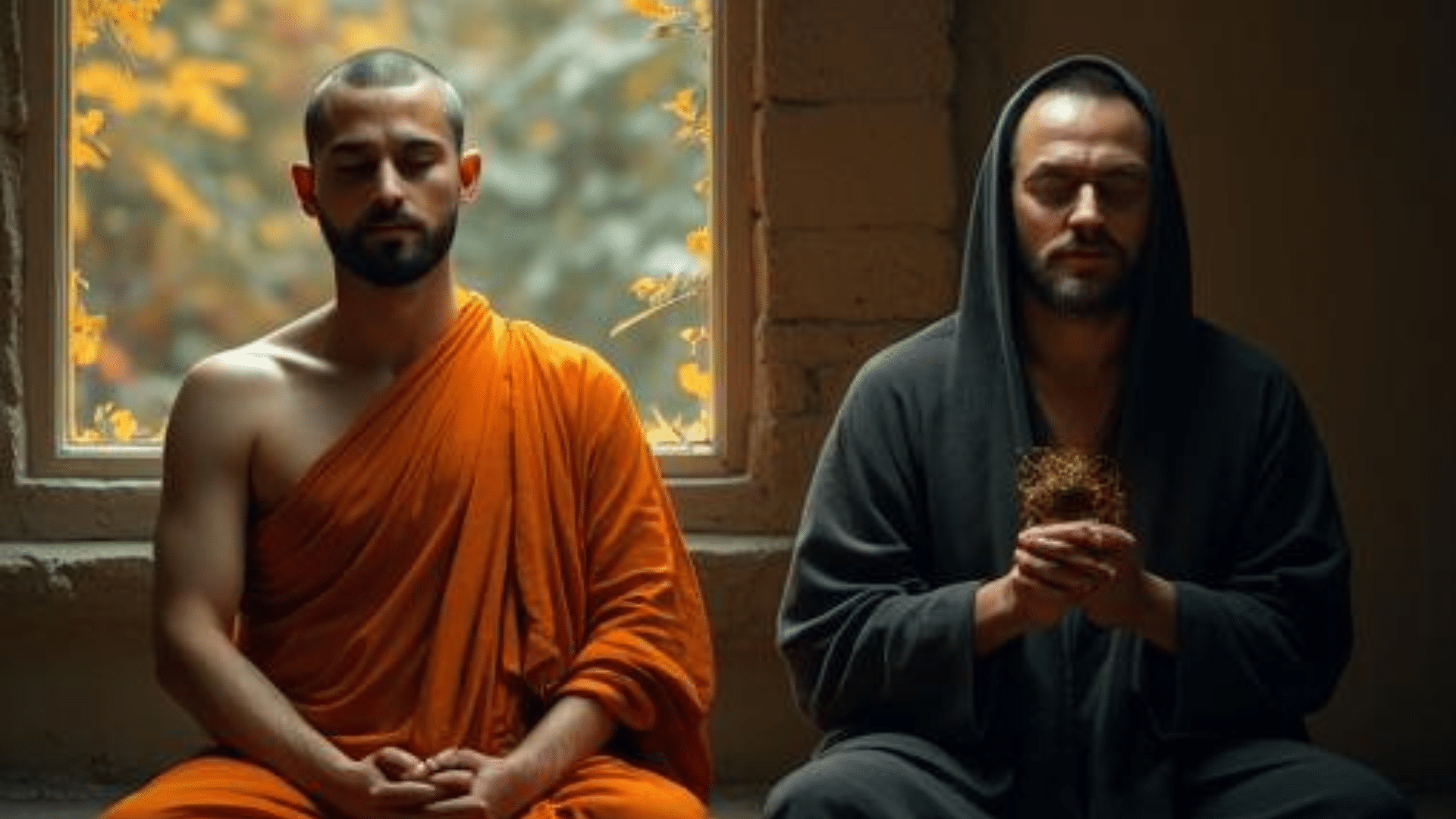
Buddhist Meditation vs Christian Prayer
I was first exposed to Christian Contemplative prayer in my early 20s. A mentor of mine introduced me to the writings of Brother Lawrence, Madame Guyon, Fenelon, and the Desert Fathers. The idea was simple – learn the practice of praying without ceasing. This meant that you developed an inner conversation with the Divine while maintaining your regular tasks throughout the day.
Brother Lawrence used to speak of an inner communion with God while doing the dishes, or cleaning up after the meals. When he was in dialogue with others, he was running an interior check-in to see if his words were proper and if the Divine wanted him to speak anything in particular.
I started the practice myself and learned that a regular practice of focusing my attention on my belly/heart area resulted in a sense of the Divine Presence there. In the beginning, it was difficult to feel this, and I almost gave up the practice, but a consistent effort soon produced the ability to quickly access this check-in. As I entered an elevator, I would close my eyes and focus my attention there. While sitting at a red light, I’d do the same. Throughout my day I would find opportunities to touch base with the Source.
A few years later, I developed an interest in the Buddhist practice of meditation. It was incredibly similar to the lifestyle I’d already established, but I discovered that the intention of the practice was different. However, far from clashing with my practice, I learned that understanding the thoughts and practices of Buddhism actually deepened my own practice.
Yes, there were differences, but there were many overlaying priorities. Over the years, my own views have evolved and I now find I pull from both traditions to build a framework that fits my understanding.
I think it’s important to recognize the differences while also giving room to welcome the places of common thread.
Watch the Video Here
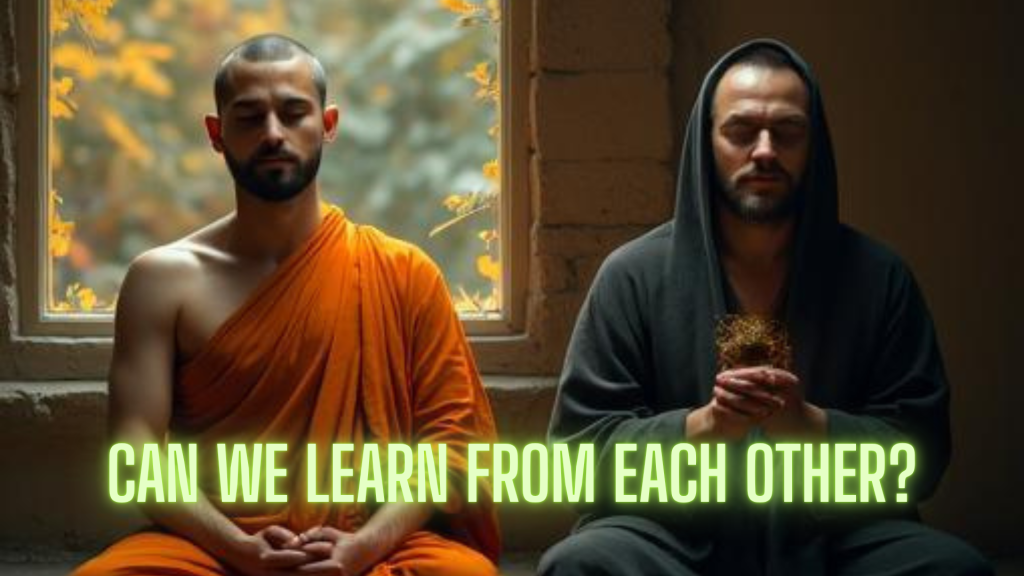
Why Comparing These Two Traditions Is Not Disrespectful
There is a long history of practitioners from both Buddhism and Christianity who have crossed this boundary with deep seriousness and deep respect. Thomas Merton, the Trappist monk, traveled to Asia specifically to sit with Buddhist masters. Thich Nhat Hanh — a Vietnamese Zen monk — has written at length about the Jesus of the Gospels as a bodhisattva figure. Bede Griffiths merged Benedictine monasticism with the Advaita Vedanta tradition in an ashram in South India.
These were not confused people. They were among the most serious contemplatives of the twentieth century. What they found was not that the traditions were the same, but that sitting with another tradition’s depths could illuminate their own.
The goal of comparison, as practiced here, is never to ignore differences. It is to see more clearly by looking from two angles at once.
The Goals: Liberation vs. Union with God
The most important difference between these two traditions lies not in technique but in telos — the ultimate aim of the practice.
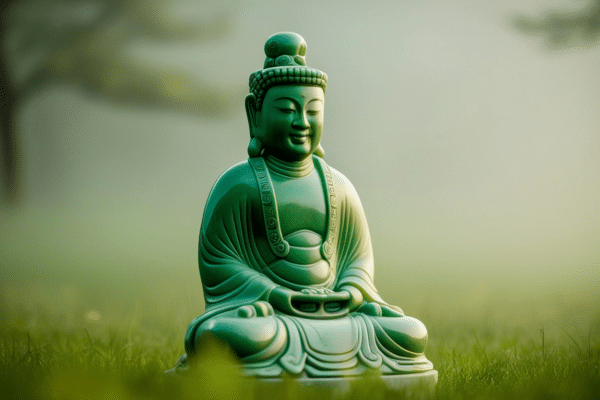
The Buddhist Goal: Liberation
In Buddhism, meditation is aimed at liberation from suffering (dukkha). The root cause of suffering, in the Buddhist analysis, is not sin or separation from God, but craving and clinging to things, whether that be material possessions, reputation, or even enlightenment itself. We do this because of a fundamental misunderstanding of reality: the illusion of a fixed, permanent self.
Many forms of Hinduism teach that there is a Divine Consciousness, the Ultimate fundamental reality. Our true Self (with a big ‘S’) is one with this Divine Source. But our ego self (small ‘s’) is a false identity that we wear. So I, John Daugherty, am a white male, 50 years old. I’m a father, a construction project manager, and a spiritual seeker. All of these are constructs of my ego self. They are not who I truly am at my core. If reincarnation is a reality, my Self would always remain the same, while my (ego) self would change in each life.
Buddhism aims to reform this Hindu idea by claiming that both the self and the Self are illusions. There is, in fact, no self/Self at all.
Meditation practice, in this Buddhist frame, is a systematic investigation of experience. The practitioner learns to see thoughts, sensations, and emotions as they actually are: impermanent, arising and passing, empty of inherent self/Self. The result — however gradually it comes — is freedom. Not happiness in the conventional sense, but the end of the grasping that generates suffering.
The Christian Contemplative Goal: Union with God
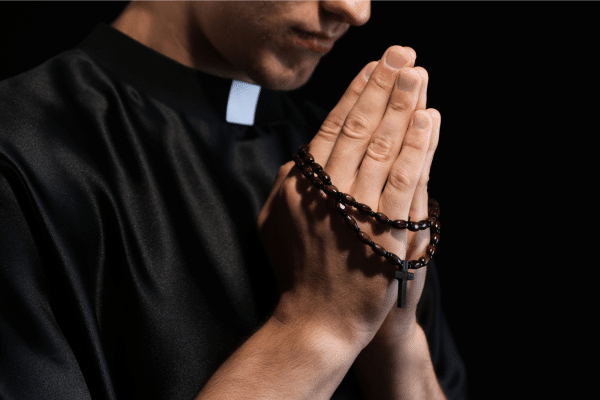
Christian contemplative prayer operates in a fundamentally different metaphysical universe. Here, there is a Creator God — personal, loving, and relational — and the human soul is not illusory but beloved. The problem is not that the self does not exist; it is that the self has turned away from its Source. In this way, it’s much more aligned with Hinduism than with Buddhism.
Contemplative prayer, in the tradition of the Desert Fathers, the medieval mystics, and modern teachers like Thomas Keating and Cynthia Bourgeault, is a practice of opening and surrender to the Source. The practitioner is not emptying the self to reveal its non-existence, but making space for divine presence to fill what it already indwells. The movement is toward union with God.
The differences here are real. A Buddhist teacher would push back strongly against the idea of a permanent, divine Self. A Christian contemplative would question whether liberation without love is truly freedom. These are not trivial distinctions.
But here’s what’s interesting: both traditions diagnose the ego as the primary obstacle to the goal. And both prescribe silence, stillness, and sustained attention as the cure.
Techniques Compared
|
Buddhist Meditation |
Christian Contemplative Prayer |
|
|---|---|---|
|
Ultimate Goal |
Liberation (nirvana); freedom from suffering and the illusion of a fixed Self |
Union with God; deepening love and surrender to the Divine |
|
View of Self |
The self is illusory or constructed (anatta) |
The self is beloved by God, but must be surrendered to him |
|
Role of Silence |
Silence reveals the nature of the mind and reality |
Silence opens space for God to speak and be received |
|
Primary techniques |
Breath focus, Vipassana, loving-kindness (Metta) |
Lectio Divina, Centering Prayer, the Jesus Prayer |
|
Mantra / Word Use |
Mantra used to focus and transcend conceptual thinking |
Sacred word (e.g., ‘God’, ‘love’) used to consent to divine presence |
|
Body’s Role |
Posture and breath are central instruments of practice |
Posture matters; some traditions use prostration, kneeling |
|
Community Context |
Sangha (community) supports practice; monastic traditions are strong |
Church community; monastic traditions (Benedictine, Trappist) |
|
Foundational Texts |
Pali Canon, Dhammapada, Zen koans |
Psalms, Desert Fathers, The Cloud of Unknowing |
Breath Focus (Buddhist)
The most common entry point into Buddhist meditation is breath awareness — simply attending to the sensation of breathing, returning repeatedly when the mind wanders. This practice, called anapanasati in Pali, is not about controlling the breath but observing it.
Over time, sustained breath awareness reveals the impermanent, shifting nature of all experience, weakening the habitual identification with passing thoughts and feelings.
Lectio Divina (Christian)
Lectio Divina — literally ‘divine reading’ is a practice as old as the monastic movement itself. A short passage of scripture is read slowly, often aloud, not to extract information but to allow a word or phrase to arise from the text and settle in the heart.
The practitioner then moves through stages: reading (lectio), meditation (meditatio), prayer (oratio), and contemplation (contemplatio). The goal is not analysis but receptivity.
Mantra (Both Traditions)
Mantra practice exists in both traditions, though with different rationales.
In Buddhist practice — particularly in Tibetan Vajrayana — mantras are used to purify mental obscurations and invoke the qualities of the awakened mind. Through the repetition of the mantra, the mind relaxes and a sense of deep stillness is experienced.
In Christian practice, the use of a sacred word is central to Centering Prayer, developed by Thomas Keating and Basil Pennington in the 1970s from the older tradition of The Cloud of Unknowing. The sacred word is not a mantra in the Hindu or Buddhist sense — it is a symbol of the practitioner’s consent to God’s presence. When thoughts arise, the word is returned to — gently, without effort — not to suppress thought but to re-anchor intention.
Centering Prayer (Christian)
Centering Prayer is perhaps the Christian contemplative practice most structurally similar to Buddhist meditation. It involves sitting in silence, choosing a sacred word, and returning to that word whenever one becomes aware of thoughts, feelings, or sensations. The movement is toward the depth of one’s being — what Keating calls the ‘True Self’ — where God is already present. The practice lasts twenty minutes, twice daily, in its classical form.
What is striking for modern seekers is that Centering Prayer looks, from the outside, almost indistinguishable from mantra-based Buddhist practice. And yet the practitioners would describe what they are doing in completely different terms.
What Practitioners of Each Tradition Say About Silence
Both traditions share a deep reverence for silence — but the silence they point to is not quite the same silence.
“Silence is God’s first language; everything else is a poor translation.” — Thomas Keating
For the Christian contemplative, silence is not emptiness — it is fullness. It is the background against which God speaks, and the medium through which God is received. The Desert Fathers fled the cities of the Roman Empire not to find peace but to find God — and they discovered that the noise they carried inside was more difficult to escape than the noise of Alexandria. Silence, in the Christian tradition, is relational: it is the attentive posture of a creature before its Creator.
“The most precious gift we can offer anyone is our attention. When mindfulness embraces those we love, they will bloom like flowers.” — Thich Nhat Hanh
In Buddhist practice, silence serves a different but complementary function. It is not so much the language of God as it is the condition in which reality can be seen clearly. The chattering mind obscures the present moment — not because God is hidden behind it, but because the constant movement of thought prevents direct perception of what is. Silence, in this frame, is the natural state that emerges when craving, aversion, and conceptual elaboration settle down.
The paradox is this: for both traditions, ordinary mental noise is the obstacle. For both, sustained practice in silence transforms the practitioner. And practitioners from both streams often describe experiences that, when stripped of theological language, sound remarkably similar — a sense of expansive, groundless awareness; a quality of knowing that does not depend on thought; a peace that does not depend on circumstances.
How to Draw from Both as a Modern Seeker
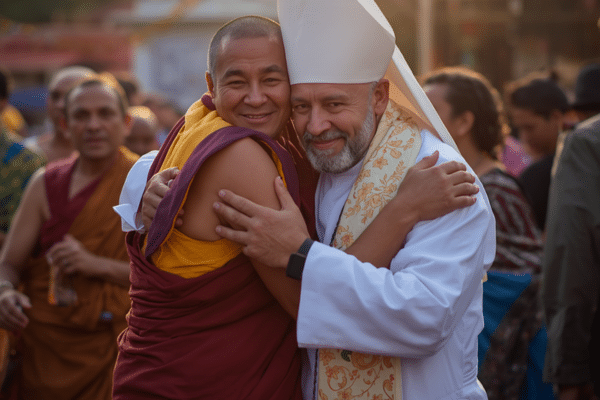
If you have resonances with both traditions — or if you have been formed by one and are curious about the other — what’s useful here?
A few suggestions from the ancient wisdom tradition itself:
- Start with one practice and go deep before going wide. Spiritual tourism — moving from technique to technique without sustained engagement — rarely produces the transformation either tradition is pointing toward. Choose one practice, commit to it for at least thirty days, and notice what it reveals.
- Learn about one tradition while practicing the other. Reading about Centering Prayer while you practice breath meditation does not dilute your meditation — it deepens it. Understanding why Christian mystics value silence can illuminate your own relationship to it. The point is insight, not synthesis.
- Pay attention to where the traditions agree about obstacles. Both Buddhism and Christian contemplative practice name the ego — the habitual patterns of self-centered thinking — as the primary barrier to the practice’s goal. You do not need to resolve the metaphysical differences to work with this insight directly.
- Find a guide or community, even informally. Neither tradition designed these practices for isolated individuals. The Buddhist concept of sangha (community) and the Christian concept of spiritual direction both point to the same reality: transformation that happens in relationship tends to go deeper.
For Buddhism: ‘The Miracle of Mindfulness‘ by Thich Nhat Hanh.
For Christian Contemplative Practice: ‘Open Mind, Open Heart‘ by Thomas Keating.
For the dialogue between them: ‘The Good Heart‘ by the Dalai Lama;
‘Zen and the Birds of Appetite‘ by Thomas Merton.
The Surprising Common Ground
After laying out the differences honestly, here is what I find genuinely surprising: the closer you get to the core of either practice, the more the language converges.
A consistent meditation practice brings the practitioner to a place of mindful awareness, a place where you (the Observer) rest in poised readiness. Not being pulled by thoughts and emotions, but just aware.
The great Buddhist teacher Ajahn Chah described this meditative awareness as ‘the one who knows’ — a quality of luminous, undisturbed knowing that is prior to thought.
The fourteenth-century Christian mystic Meister Eckhart called it ‘the ground of the soul’ — the deepest level of the self where it is already united with God.
Thomas Merton called it ‘le point vierge’ — the virgin point, the place of primordial clarity before the ego constructs its architecture.
These are different descriptions of the same phenomenon.
The Sufi poet Rumi said: ‘Out beyond ideas of wrongdoing and right doing, there is a field. I’ll meet you there.’ Something in both Buddhist and Christian contemplative practice points toward that field — not because the traditions are the same, but because they are both aiming their most serious practitioners toward a depth of human experience that may be prior to the categories we use to divide them.
A Final Word
Every great contemplative tradition I have studied carries the same essential message about the life of practice: the most important thing is to begin, and the second most important thing is to continue.
Whether your spirituality path leads you through a Buddhist meditation hall, a monastery chapel, both, or neither — the ancient wisdom traditions are not primarily asking you to believe the right things. They are inviting you into a practice of attention, honesty, and opening. What you find there may surprise you.
The field is out beyond the categories. Keep walking toward it.
FAQs:
Can a Christian practice Buddhist meditation without conflict?
Many Christian practitioners — including Trappist monks and mainstream contemplatives — have integrated Buddhist mindfulness techniques into their prayer lives without abandoning Christian theology. The key distinction most make is between techniques (which can be broadly applicable) and the theological framework that gives them meaning. Father Thomas Keating himself acknowledged Buddhist parallels to Centering Prayer and found the cross-tradition conversation generative rather than threatening.
Is Buddhist meditation ’emptying the mind’?
This is one of the most common misconceptions about Buddhist practice. Meditation does not aim to produce a blank or empty mind — it aims to develop a quality of stable, non-reactive awareness that can observe the contents of the mind without being swept away by them. The ’emptiness’ (shunyata) that some Buddhist traditions reference is a philosophical claim about the nature of reality, not an instruction to think of nothing.
What is the difference between Centering Prayer and mindfulness meditation?
Both involve sitting in silence and working with a focal point (the sacred word in Centering Prayer; the breath or another anchor in mindfulness). But their intentions differ significantly. Mindfulness, in most contemporary forms, cultivates present-moment awareness for its own sake — noticing what arises without judgment. Centering Prayer uses the sacred word as an expression of consent to divine presence — the goal is not awareness itself but deepening relationship with God. The structure looks similar; the inner orientation is different.
Do I need to be religious to benefit from contemplative practices?
No. The attentional and emotional benefits of both meditation and contemplative prayer are well-documented and accessible regardless of religious belief. That said, both traditions would suggest that stripping a practice entirely of its wisdom context — the philosophy, the ethics, the community — tends to produce shallower results over time. The practices are most powerful when held within some larger framework of meaning, even if that framework is your own.