Intro
You already know the cycle. Something goes wrong. The frustration—or grief, or anger, or powerlessness—builds until it becomes unbearable. And then you reach for something to make it stop. The bottle. The vape. The drive-through. The app. Whatever your something is, you already know it isn’t solving the problem. It’s just dimming the signal for a while.
But here’s what 2,000 years of Stoic philosophy—and a surprisingly honest read of the 12-step tradition—can tell you: the problem was never the coping mechanism. And the solution has nothing to do with willpower.
The answer lives in a Latin phrase: Amor Fati—the love of fate. And understanding it might be the most important thing you do today.
Watch the Video Here

One Sentence That Explains Every Addiction
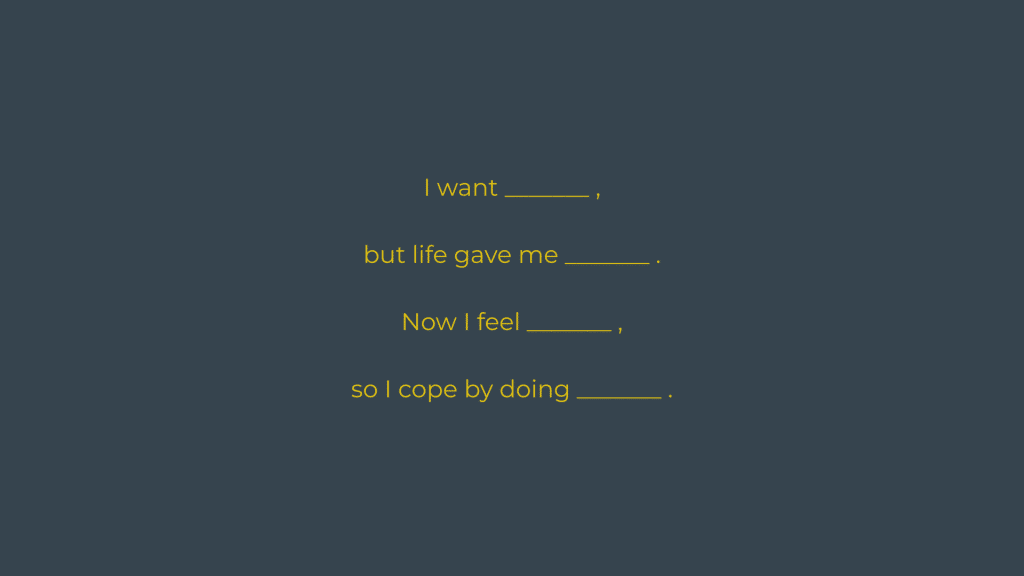
Across every culture, every century, and every kind of human struggle, addiction follows the same structure. Fill in the blanks:
“I want _______, but life gave me _______. Now I feel _______ so I cope by doing _______.”
It doesn’t matter what fills those blanks. The specifics change—the structure never does. This is the universal grammar of human suffering, and every tradition of wisdom humanity has ever produced has had something to say about it.
Most of our attempts to address addiction focus on the last blank. If I can just eliminate the drinking, the overeating, the gambling—then I’ll be okay. So we empty the pantry. We delete the app. We white-knuckle our way through another week.
But those things are not your problem. They are your subconscious mind’s best attempt to cope with your problem. Remove the mechanism, and the pressure that created it remains. The steam always finds a new valve.
What About Just Letting Go of Your Goals?
Maybe the problem is the first blank—desire itself. Doesn’t Buddhism teach that attachment is the root of all suffering? Should we simply un-want the things we want?
This is a misreading of the Buddha, and it’s also a misreading of human nature. Go anywhere on the planet, study any human population across any epoch of history, and you will find evidence of goals and ambitions. Purpose is not a Western invention or a modern pathology—it is a feature of being human. Remove purpose from a life, and what you are left with is not peace. It is emptiness.
Those who have walked through depression know this intimately. The fog of depression is not characterized by too much desire. It is characterized by the total absence of it. Coming out of that fog is almost always accompanied by the re-ignition of something to live for. The first blank is not your problem.
The Middle Blanks: Where Addiction Actually Lives
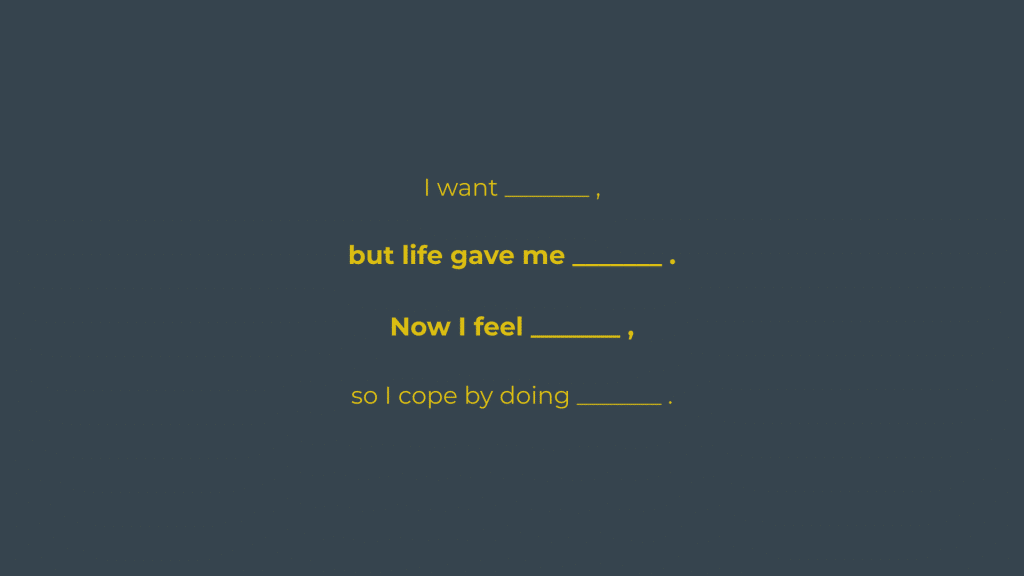
Look at the sentence again. But life gave me _______. Now I feel _______. This is where the work is. This is where your addiction lives—not in the substance or the behavior, but in the gap between what you expected from life and what life actually delivered.
Life is not a math problem. It does not produce straight lines. You set a course, and the path meanders—sometimes gently, sometimes so dramatically that it looks like a child scribbled over the map. You get fired. You receive a diagnosis. You lose someone you can’t imagine losing. The pregnancy was not planned. The coworker’s lie changed everything.
These are not abstract inconveniences. They are seismic events that produce seismic emotions—anger, grief, frustration, humiliation, fear. And here is the thing that is critically important to understand: those emotions are not wrong. They are not a sign of weakness. They are not sins. They are a natural and appropriate response to being human in a world that does not cooperate with your plans.
We don’t reach for the bottle because life gave us an obstacle. We reach for it because we cannot bear how we feel about the obstacle. The addiction lives in the resistance—the refusal to sit inside the discomfort of those middle blanks.
Amor Fati: The Stoic Art of Loving What Happens
The Stoics were not optimists in the modern, Instagram-friendly sense of the word. They were not telling you to look on the bright side or count your blessings. They were proposing something far more demanding—and far more honest.
Amor Fati—love of fate—is the practice of not merely accepting what happens, but actively embracing it. The philosopher Friedrich Nietzsche, who popularized the phrase, saw it as the highest affirmation a human being could make. The Stoic emperor Marcus Aurelius put it plainly:
“You have power over your mind, not outside events. Realize this, and you will find strength.”
— Marcus Aurelius, Meditations
Notice what he says, and what he does not say. He does not say the outside event was good. He does not say you should pretend it didn’t hurt. He says: you have no power over it, and you have complete power over how you respond to it. That is the whole of the Stoic project.
Amor Fati takes this one step further. It asks you not just to endure what fate delivers, but to recognize that the obstacle belongs in your story. That it is not a detour from your path—it is your path. The meandering curves of life are not punishment. They are the curriculum.
The Higher Power Connection: Ancient Wisdom in the 12 Steps
If you or someone you love has spent time in a 12-step meeting, this will sound familiar. One of the foundational moves in that tradition is the acknowledgment of a Higher Power—something larger than yourself, something that, in some sense, has your best interests in mind.
The specifics of that Higher Power are intentionally left open. It can be God, the Universe, Nature, Life with a capital L, or your own deepest subconscious wisdom. What matters is the recognition: there is something bigger than me, and it is not malicious toward me.
This is not mere comfort theology. It is a functional shift in how you interpret the middle blanks of that sentence. When life gives you what you did not want, you have two choices in how you narrate that event: the Higher Power is punishing me, or the Higher Power is preparing me. The Stoic tradition and the 12-step tradition—separated by centuries and continents—arrive at the same conclusion: surrender is not defeat. It is wisdom.
The Sufi poets understood this as well. Rumi wrote of the reed’s cry being the very sound of separation—and that separation being the beginning of the journey toward union. The wound is not the end of the story. The wound is how the light gets in.
The Desert Fathers of early Christianity called it apatheia—not the absence of feeling, but the freedom from being enslaved by reactive emotion. The goal was not to stop feeling anger or grief. The goal was to feel it fully, process it honestly, and not be controlled by it.
Putting Amor Fati Into Practice: A Path Out of the Cycle
Understanding Amor Fati intellectually is one thing. Living it when you’ve just been passed over for a promotion—again—is another. Here is what this actually looks like in practice.
1. Name the emotion without judgment
When the obstacle arrives and the emotion rises, don’t run from it and don’t perform equanimity you don’t feel. Name what is actually present. I am angry. I am afraid. I am devastated. This is not weakness. This is the beginning of processing rather than suppressing.
2. Separate the event from your response
Marcus Aurelius kept returning to this distinction. The event itself—the firing, the diagnosis, the betrayal—was outside his control. It belonged to the category of things no amount of willpower could change. What remained in his control was the orientation of his mind. This is not denial; it is precision. You are not pretending the wound doesn’t hurt. You are refusing to let the wound make all your decisions.
3. Turn toward, not away
The coping mechanism is always a turning away—from the emotion, from the obstacle, from the discomfort of sitting in the middle blanks of that sentence. Amor Fati asks you to turn toward it. Sit in it. Let the anger burn until it has nothing left to consume. Let the grief move through you. Complain to your Higher Power if you need to—the Psalms are thousands of years of evidence that this is not only acceptable but holy. Then, when the emotion has run its course, ask: What is this preparing me for?
4. Look for the curriculum
This is the hardest step—and the most transformative. Every meaningful ancient wisdom tradition holds that life is a school, not a punishment. The Bhagavad Gita frames Arjuna’s crisis on the battlefield as the necessary condition for his awakening. The Book of Job holds that suffering is not the absence of divine care but the presence of a process too large to see from inside it. The Stoics called obstacles the way—not detours around it.
You may not be ready yet for the goal you set. That is not a criticism. It is simply the assessment of a process that sees more of your story than you currently can. The delay, the detour, the disappointment—these are the conditioning, not the consolation prize.
5. Interrupt the pattern before it completes
The moment you notice the pull toward your coping mechanism, you are at a decision point. This is where Amor Fati becomes a practical intervention. Instead of reaching for the numbing agent, pause. Turn toward your Higher Power. Name the emotion. Refuse to let the pattern complete itself. Ask what this moment is teaching you.
This is not a one-time fix. It is a practice—the same kind of practice that the Stoics and the Buddhists and the contemplatives of every tradition have always described. A practice, by definition, is something you return to, not something you perfect. Give yourself the same patience you would offer a student who is genuinely trying to learn.
Different Maps, Same Territory
What is remarkable—and deeply encouraging—is how many wisdom traditions arrive at this same destination through their own unique paths.
- Stoicism names it Amor Fati—the love of fate, the embrace of what is.
- Buddhism teaches non-attachment—not the absence of desire, but the freedom from being destroyed by outcomes.
- Taoism offers Wu Wei—flowing with what is, rather than forcing what isn’t.
- Sufism speaks of fana—the dissolution of the ego’s resistance into the larger will of the Beloved.
- Contemplative Christianity describes it as surrender to divine providence—the trust that the story is not over and the Author is not cruel.
- Jewish Wisdom holds Teshuvah—return. The turning back toward the path, even after—especially after—you have wandered.
These are not competing systems offering contradictory prescriptions. They are different maps pointing toward the same territory: the liberation that comes from releasing the grip of your expectations on life’s unfolding.
You’re Not Ready Yet—And That’s the Point
Here is perhaps the most counterintuitive part of this: if you haven’t reached your goal yet, it may simply be because you are not yet ready to hold it. That is not an insult. It is the logic of a curriculum.
The person you will be when you arrive at your goal is someone who has been shaped, tested, stretched, and prepared by everything that happened on the way. The obstacles were not detours from your formation. They were your formation.
If you learn to surrender to this process—if you learn to love the fate that life has laid out for you—you will eventually reach your goal. And when you get there, you may find that the goal you originally set wasn’t nearly ambitious enough. You didn’t know it at the time. The process did.
The addiction cycle begins in resistance. It ends in surrender. Not the surrender of giving up, but the surrender of a warrior who has finally understood that the real opponent was never outside—it was always the refusal to feel, to process, and to trust.
Amor Fati. Love your fate. Not because it is easy, but because it is yours—and it is taking you somewhere your present self cannot yet see.
FAQs:
What is Amor Fati and how does it apply to addiction?
Amor Fati is a Latin phrase meaning “love of fate,” central to Stoic philosophy. Applied to addiction, it offers a framework for understanding why we reach for coping mechanisms: we are resisting the emotions that arise when life doesn’t follow our expected path. Amor Fati teaches us to turn toward those emotions rather than escaping them, interrupting the cycle at its root rather than at its symptoms.
Is Amor Fati the same as just accepting your circumstances?
Amor Fati goes beyond passive acceptance. Where acceptance says “I can live with this,” Amor Fati says “I embrace this as belonging to my story.” It is an active, even loving orientation toward what life brings—including the painful parts—because of the conviction that those experiences are preparing you for what comes next.
How is this different from traditional addiction treatment?
Traditional approaches often focus on the coping mechanism itself—eliminating the substance or behavior. This philosophical framework focuses on the middle of the addiction sentence: the gap between what we expected and what we received, and how we feel about that gap. It complements rather than replaces clinical treatment, offering a meaning-making layer that can sustain recovery over the long term.
Do I need to believe in God for this to work?
No. The concept of a Higher Power in this framework is intentionally non-dogmatic. It can be the God of any religious tradition, the Universe, Nature, or even your own deepest subconscious wisdom. What matters is the functional shift: recognizing that something larger than your current perspective is at work, and that this something is not malicious toward you.
Can Stoicism really help with addiction?
Stoicism doesn’t promise to cure addiction, and it is not a substitute for professional support when that support is needed. But the Stoic practice of distinguishing between what is and is not in our control, and of processing emotions without being enslaved by them, addresses the psychological root of many addictive patterns in a way that is both ancient and surprisingly consistent with modern therapeutic approaches like Acceptance and Commitment Therapy (ACT).
What other ancient traditions address addiction?
Many traditions offer wisdom relevant to the addiction cycle. Buddhist teachings on non-attachment address the suffering caused by clinging to outcomes. Taoist philosophy’s concept of Wu Wei (non-forcing) parallels the Stoic idea of accepting what we cannot control. Sufi spirituality’s emphasis on surrender and the contemplative Christian tradition’s teaching on divine providence both speak to the liberation that comes from releasing resistance to life’s unfolding. The convergence across traditions is remarkable—and instructive.